
Demilec Attic Insulation in Las Vegas: A Homeowner’s Guide
Demilec attic insulation in Las Vegas means spray foam, and spray foam is the one attic material that air-seals, vapor-blocks and stiffens a roof deck at the same time. In the Mojave, that combination matters more than it does anywhere else in the country, because your attic isn’t storage space in July. It’s a furnace running at 160°F, and most insulation products were never engineered to hold their numbers at that temperature. If you’d rather not sort through R-value charts and venting rules yourself, call (844) 560-6351 and we’ll walk you through it in plain English.
Why Las Vegas Attics Are a Different Animal
Las Vegas doesn’t get hot the way most of the country gets hot. It gets relentlessly hot, then it cycles. An attic in Summerlin might hit 155°F to 165°F by early afternoon and drop 40 degrees overnight, then do it again the next day, roughly 120 days a year. Fiberglass batts handle that cycle by quietly losing effective R-value as temperatures climb, because the material’s performance rating is tested under moderate conditions that don’t describe your roof. Spray foam holds its R-value much more steadily in heat, and that gap is where the savings live.
The second thing people miss: most Las Vegas homes built before the mid-2000s have vented attics where the insulation sits on the floor and the roof deck bakes unprotected. Ductwork runs through that same oven. We’ve measured supply ducts in older Henderson homes running 40 to 50 degrees hotter than the conditioned air inside them, which means your air conditioner is paying to cool a space that’s actively heating the air back up. That’s not a comfort problem. That’s a monthly bill problem.
Demilec is a spray foam manufacturer whose formulas we install, and its closed-cell and open-cell products behave very differently under this kind of heat. Knowing which one belongs in your attic is the whole ballgame. Our Warmline Insulation Las Vegas home page lays out the full scope of what we handle, but the short version is this: the wrong foam for your assembly can trap moisture or underperform, and the right one can change how your house feels overnight.
Closed-Cell vs. Open-Cell: Which Demilec Product Fits Your Attic?
The honest answer is that it depends on how your attic is built, not on which product sounds better. Demilec’s closed-cell foam lands around R-6.5 to R-7 per inch and cures rigid. Open-cell runs roughly R-3.6 to R-4 per inch and cures softer. In Las Vegas, the decision usually comes down to vented versus unvented assembly:
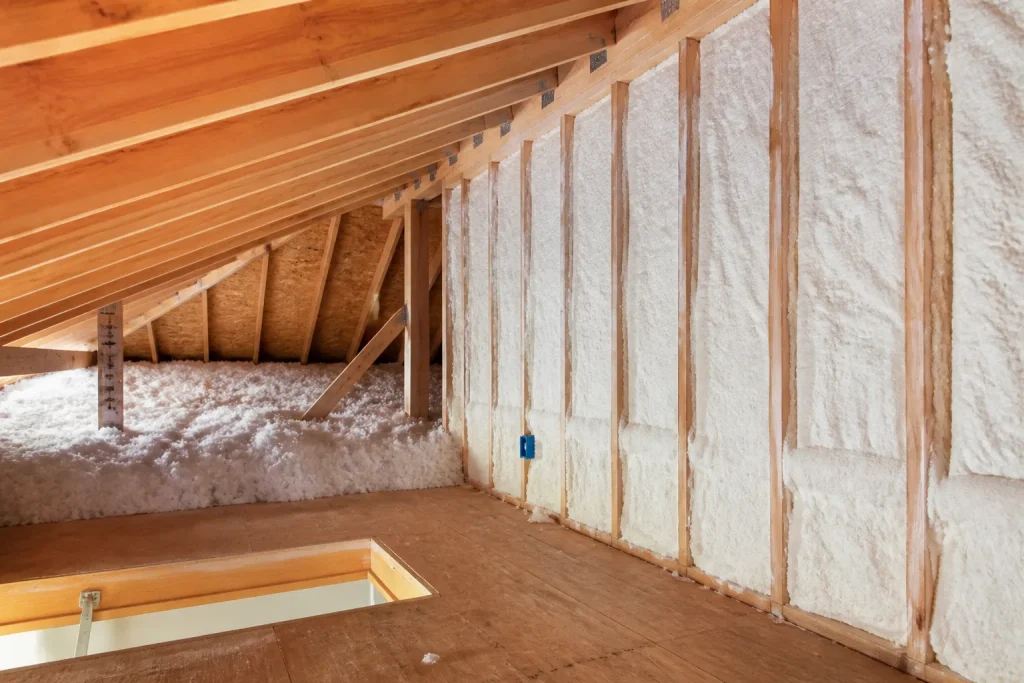
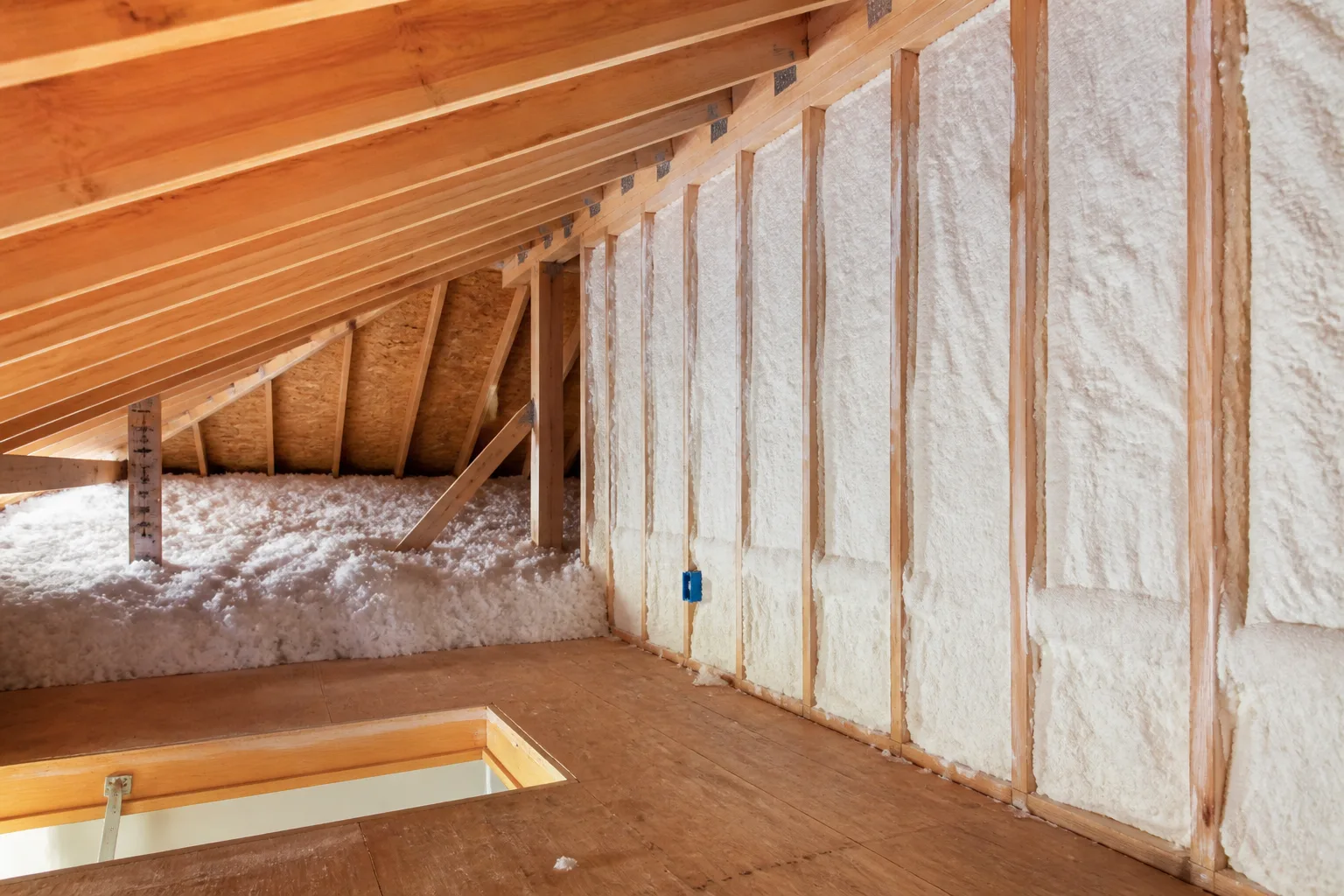
- Closed-cell (Demilec Heatlok-type formulas): Best for roof-deck applications in unvented or conditioned attics. It air-seals on contact, acts as a vapor retarder, adds structural rigidity to the deck, and holds R-value at high temperatures. This is what we reach for when a Las Vegas homeowner wants the attic inside the building envelope.
- Open-cell: Works well on attic floors over existing venting, fills odd cavities and penetrations nicely, and costs less per board foot. It’s vapor-permeable, so it needs the right assembly underneath it, and it isn’t the choice for a hot roof deck in direct Mojave sun.
- R-value targets for Clark County: Most Las Vegas attics want R-38 to R-49 at the ceiling line. Closed-cell gets you there in a thinner profile, which matters in low-slope roofs where every inch of headroom counts.
- Duct location: If your ducts run through the attic, moving them inside the conditioned space is often the single biggest comfort win, and closed-cell foam on the deck is what makes that possible.
One caution worth stating plainly: closed-cell foam is a two-part chemical reaction, and it’s not a homeowner project. It’s also not a job for a generalist who sprays foam twice a year. Proper substrate prep, moisture readings and thickness control all determine whether the foam performs for 30 years or fails in three.
The Air-Sealing Advantage: Monsoons, Wind and Pressure
Las Vegas gets roughly 4 inches of rain a year, and it tends to arrive all at once. During monsoon season, wind-driven rain and rapid pressure changes push outside air through every gap in your attic floor: top plates, can lights, plumbing penetrations, the seam where the wall meets the ceiling. That infiltration is the dominant driver of heat gain in most Las Vegas homes, and it’s not something a batt of fiberglass can stop, because batts sit around obstacles rather than sealing them.
Spray foam applied to the roof deck or the attic floor bonds to the substrate and closes those paths. That does three things in a Las Vegas house:
- It stops hot, dusty summer air from being drawn into the return side of your HVAC system through the attic.
- It keeps wind-driven moisture out during monsoon storms, which matters in a climate where a small roof leak can go unnoticed for months.
- It reduces household dust and pollen load, because the attic stops acting like a leaky lung.
We’ve seen this play out repeatedly in the older neighborhoods around North Las Vegas, where homes from the 1970s and 1980s have attics that were originally vented hard and sealed lightly. If your attic has ever smelled like hot dust when the AC kicks on, or if you’ve found fine granular dust settling on the tops of your ceiling fans, that’s pressure-driven infiltration, and it’s exactly what foam was built to fix.
R-Value Retention at 160°F: Where the Numbers Come From
Every insulation product carries a rated R-value, and every rated R-value assumes a test condition. Fiberglass batts are typically tested at a median temperature around 75°F. Put them on a Las Vegas attic floor and their effective R-value can drop meaningfully as the temperature above them climbs. That’s not a knock on fiberglass, which is a good product in the right climate and a legitimate choice when paired with strong air sealing. It’s simply a physics problem: heat moves through fibrous material faster when the temperature difference across it is 140 degrees instead of 30.
Closed-cell Demilec foam holds its R-value much more consistently in high heat because its cell structure is sealed and rigid, and the gas inside those cells doesn’t circulate. That’s why we routinely specify it for roof-deck applications in Las Vegas where the deck itself is going to sit above 150°F every summer afternoon for the next 30 years. The deck is also where that heat radiates straight down onto your ceiling. Foam on the underside of the deck stops it there, before it ever becomes a load on your air conditioner.
If you want the deeper comparison across material types, our page on Attic Insulation in Las Vegas goes through batts, blown-in and foam side by side. Demilec is one of the material lines we install, alongside brands like Rockwool and Icynene, and we choose per house rather than per habit.
Conditioning the Attic: What It Means for Nevada HVAC
Moving the attic inside your home’s insulation boundary is the single biggest comfort decision a Las Vegas homeowner can make, and it’s the part most people haven’t considered. When the roof deck is insulated and sealed with closed-cell foam, the attic becomes conditioned space by default. It runs maybe 5 to 10 degrees warmer than the house instead of 60 degrees warmer.
That changes how your HVAC system works. Ducts running through the attic stop losing cold air before it reaches the registers, which is why bedrooms over garages and rooms at the far end of the house often feel like they’ve been fixed overnight. Equipment runs shorter cycles because it isn’t fighting a 160°F attic. And because the foam is also a vapor retarder and an air barrier, you’re not introducing a moisture problem in the process. That’s a meaningful consideration in Nevada’s dry climate, where a vapor barrier needs to be located correctly rather than just applied thickly.
This is also where we point homeowners toward our Crawl Space Encapsulation & Vapor Barrier in Las Vegas page. A conditioned attic and a sealed crawl space work as two halves of the same envelope, and handling the attic alone sometimes just moves the moisture problem somewhere else.
We pulled a fiberglass batt out of an attic in Centennial last summer and it had more of its mass in rodent nesting than in glass. If your attic detail looks anything like that, foam alone isn’t the fix, and we’ll tell you so.
The 90-Day Done Right Promise and What It Covers on a Foam Job
A spray foam install isn’t finished when the truck leaves. Demilec closed-cell foam cures within about 24 hours and is fully inert after that, but the first day involves some off-gassing, and a good installation is inspected, not assumed. Here’s what our 90-Day Done Right Promise looks like in practice on a foam job:
- Cure and off-gassing: We walk you through ventilation expectations before we start and again before we leave. Most homeowners can reoccupy the space the next day. If anything smells off after our curing window, you call us, not a manufacturer hotline.
- Post-install inspection: We verify foam thickness against the spec, check for voids at the perimeter and around penetrations, confirm that no foam is blocking venting it shouldn’t, and photograph the work for your records.
- Coverage: If the foam thickness falls short, if an area was missed, or if you find a problem in the first 90 days, we come back and make it right in writing. That’s a commitment most spray foam contractors don’t put in writing, and it’s the reason we can offer it: the work is inspected before we call it done.
- One-visit expectation: Most jobs are completed in a single visit. Prep, spray, inspect, clean up, done.
When to Call a Pro
Spray foam is a chemical installation involving pressurized equipment and a two-part exothermic reaction. The chemicals require proper skin, eye and respiratory protection during application, and improper mixing or inadequate substrate prep can cause adhesion failures, off-ratio foam that never fully cures, or trapped moisture that doesn’t surface for months. A Las Vegas attic is also hot enough, and often tight enough, that a homeowner working in it without the right rig is a real health risk. This is not the job to attempt yourself, and we say that even though we’d happily take your call.
If you’re weighing spray foam against other options, our Spray Foam Insulation in Las Vegas page gets into the practical side of the install. For anything you want to diagnose first, our home energy audit is the better starting point, because it tells you whether your attic is the biggest hole in the envelope or just one of them.
Related services in Las Vegas: attic insulation, air sealing, spray foam, radiant barrier, crawl space encapsulation, insulation removal and replacement, and home energy audits. All ten under one contractor, all backed by the 90-Day Done Right Promise.
The Bottom Line
Demilec attic insulation in Las Vegas is worth serious consideration because it does three things at once that fiberglass batts do separately, and no single product does all three better under extreme desert heat. Closed-cell foam on the roof deck air-seals against monsoon infiltration, holds its R-value at 160°F, dampens heat gain through the deck, and lets your HVAC stop fighting an attic. Open-cell has its place, but not on a hot roof deck. The right answer, though, depends on how your attic is built, and that’s a conversation worth having before any spraying starts.
If you’re in Las Vegas and the attic is on your mind, Warmline Insulation Co. offers free estimates. Call (844) 560-6351 and a live person will answer, 24/7. Our technicians have up to 15 years of experience, we’re licensed and insured, and every job comes with the 90-Day Done Right Promise. Standing offers include $50 Off Any Repair Over $250, an $89 Seasonal Tune-Up, and a permanent 5% discount for seniors and veterans.
Frequently Asked Questions
How much does Demilec attic insulation cost in Las Vegas?
Closed-cell Demilec foam on a Las Vegas roof deck typically runs in the $3.50 to $7.00 per square foot range for the foam itself, and a typical 1,500-square-foot attic lands somewhere between $4,000 and $8,500 installed, depending on thickness, accessible area and whether removal or prep work is needed first. Open-cell runs lower per square foot but needs more depth to hit the same R-value. Call (844) 560-6351 for an exact quote on your house, and the estimate is free.
Which is better for a Las Vegas attic, closed-cell or open-cell?
Closed-cell is the better fit for Las Vegas roof-deck and conditioned-attic applications. It holds R-value at 160°F, air-seals, acts as a vapor retarder and adds rigidity to the deck, which matters under Mojave heat cycling. Open-cell works well over a vented attic floor where the assembly supports vapor permeability. The deciding factor is your assembly, not the product hype.
How long does Demilec spray foam last in a Las Vegas attic?
Closed-cell spray foam applied to a properly prepped and inspected roof deck is designed to last the life of the building, and we’ve seen 20-plus-year-old installs still performing in Las Vegas homes. Adhesion and thickness control at install are what determine longevity, which is why our post-install inspection and the 90-Day Done Right Promise exist. Call (844) 560-6351 and we’ll tell you honestly whether your existing foam is holding up.
Can you install Demilec insulation in my Las Vegas home this week?
Most jobs are completed in a single visit, and we schedule most Las Vegas installs within a short window of the estimate. Call (844) 560-6351 and a live person will answer 24/7, no voicemail, and give you a straight answer on availability. If your attic is currently open and venting heat, sooner is better than later, and we can typically move you up.
Written by the team at Warmline Insulation Co.
Need Insulation Help?
Call Warmline Insulation Las Vegas - licensed & insured, here with fast after-hours help in Las Vegas.
(844) 560-6351